
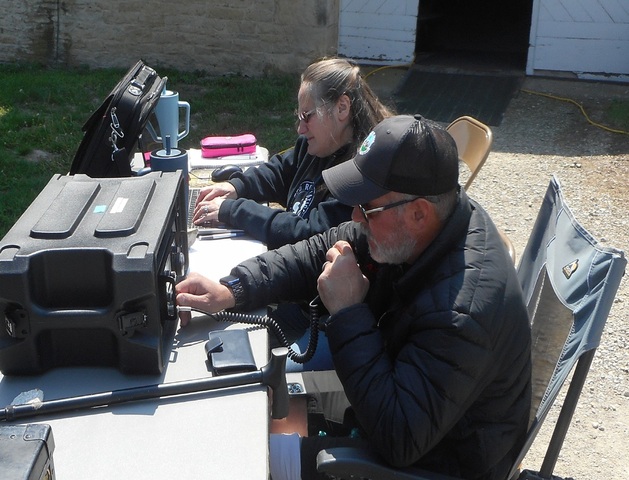
 Adam, WU0M, and Kim work the 20m band after lunch using the Go-Kit Joe, KR0UT, SK, fabricated
Listening to the weather forecast, it sounded like the SFTARC’s 2026 annual POTA operation at the Tallgrass Prairie National Preserve was going to have the feel of a winter Field Day. However, the Tallgrass team was pleasantly surprised to find the weather quite agreeable outdoors when they arrived at about 9:15 am on Saturday, April 18th. With the sun out and a row of buildings providing a wind shelter to our north, it was quickly decided to set up operation outdoors on the north side of the three-story limestone barn, rather than indoors as had previously been planned. That proved to be a good decision. It turned out to be a very nice day for outdoor operating.
The team of 11 SFTARC members quickly went to work setting up the club’s Cushcraft R5 vertical for the 20m phone station and a 30/17m trap vertical for the CW station. That was followed by a 40/15m dipole set up for the second phone station. By about 10:30 am, the first station was on the air on 20m. For the first hour, 40m produced a handful of contacts, then 40m fell off. The 20m and the 30m stations continued to make contacts using POTA designator US-3673. However, once the pizza lunch arrived—all stations abruptly went inactive for a half an hour. After lunch, a couple of scans were made on the 40, 17 and 15m bands only to find they had and virtually no activity, limiting the operation to just 20 and 30m. The two phone stations employed Icom IC-7300 transceivers, while the CW station used an Icom IC-746.
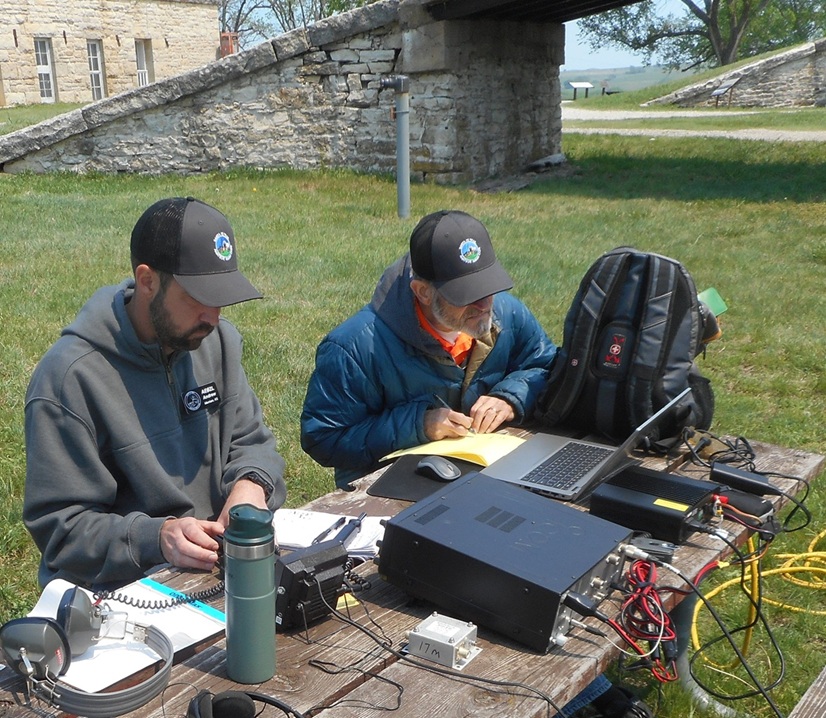 Andrew, AE0ZL, operates CW on 30m while Bob, KF0AUI, logs the contacts
During the event, operators and onlookers could look out over the freshly burnt-off prairie and at the same time smell smoke coming from a planned burn taking place to the north. Radio chatter in both voice and Morse code could be heard. Contacts continued to be logged on the laptop computers. An informational table was available to help support conversations with visitors curious about amateur radio, with a park ranger being one of the more curious individuals. One exhibit on the table was an ARRL video that introduced viewers to many of the aspects of ham radio.
A technical challenge the team had to deal with was interference being heard in the 20m station when the 30m station was transmitting. Even with the addition of bandpass filters in line with each transceiver, the interference continued. With the two stations’ vertical antennas already being 170 ft apart, trying for additional separation was not too practical. A solution was found in adding a second 20m bandpass filter in line with the 20m station.
The 100-mile trip to the Tallgrass started with seven operators departing Gardner at 6 am in a convoy, followed by a stop for breakfast at BETO Junction at 7 am, where two more club members joined the team. Another member joined the team at the Tallgrass itself.
For one member, this was his first POTA activation; for another, the first time he participated in a POTA activation using Morse code. Park Ranger Heather thanked us multiple times for putting amateur radio on display for the benefit of park visitors
By the time the team started tearing down the stations, over 50 contacts had been logged, with several contacts being park-to-park. All that was left to make the operation a success was a stop for ice cream at Braum’s in Emporia, which was successfully executed.
Thank you to all who traveled the 100 miles to participate in the Tallgrass event.